Novel Anti-Tumor Mechanism Revealed in HBV-Related HCC Research Using Cloud-Clone C3a Antibody Reagents
HUSTON, TX, UNITED STATES, September 1, 2026 /EINPresswire.com/ — Decoding the Complement System to Empower Innovation: How Cloud-Clone’s One-Stop Solutions Support High-Level Complement Research
Subtitle: Novel Anti-Tumor Mechanism Revealed in HBV-Related HCC Research Using Cloud-Clone C3a Antibody Reagents
As a core hub of innate immunity and a critical bridge linking innate and adaptive immunity, the complement system plays a key regulatory role in anti-infective defense, inflammatory homeostasis maintenance, tissue repair, and the progression of numerous diseases. With continuous global advances in precision diagnostics and targeted drug development, reliable and robust research tools have become a cornerstone for frontier breakthroughs in immunology. A landmark hepatocellular carcinoma immunotherapy study recently published in Cancer Cell leverages high-quality complement-focused research reagents from Cloud-Clone to uncover a brand-new immune response mechanism for HBV-associated hepatocellular carcinoma, opening new perspectives for cancer immunotherapy. This article reviews cutting-edge progress in complement research and introduces Cloud-Clone’s end-to-end one-stop solutions for complement-related studies.
The complement system represents one of the most dynamic and clinically valuable frontier areas in modern immunology. Serving as the central hub of innate immunity and the key bridge connecting innate and adaptive immunity, it governs host anti-infective defense, inflammatory homeostasis, tissue repair, and the onset and progression of diverse diseases. Accelerated global advancement in precision diagnostics and targeted therapeutics has rendered high-quality, highly stable research reagents indispensable to research success.
The Complement System: An Emerging Battlefield for Cancer Immunotherapy
The complement system consists of more than 50 soluble plasma proteins, membrane-bound receptors and regulatory proteins. It is activated via three pathways: the classical pathway, the lectin pathway and the alternative pathway, to exert synergistic immune effects. Activation of these three pathways converges to generate anaphylatoxins including C3a and C5a, as well as the membrane attack complex, which mediate inflammation, phagocytosis, opsonization and cytolysis.
Within the tumor microenvironment, the complement system acts as a double-edged sword. On one hand, complement activation can trigger tumor cell lysis and immunogenic cell death to boost anti-tumor immunity. On the other hand, complement activation products C3a and C5a may recruit myeloid-derived suppressor cells and regulatory T cells, forming an immunosuppressive microenvironment that dampens immunotherapeutic efficacy.
Growing evidence indicates that complement-targeted inhibition strategies exert synergistic anti-tumor effects when combined with immune checkpoint inhibitors such as anti-PD-1/PD-L1 antibodies. Targeting C3a receptor and C5a receptor 1 can reverse complement-driven immune suppression and enhance T-cell-mediated tumour rejection, paving new avenues for cancer immunotherapy.
High-Impact Journal Evidence: Cloud-Clone C3a Antibody Facilitates New Discoveries in Hepatocellular Carcinoma Immunotherapy
In July 2026, Professor Kuang Ming’s research team from the Department of Hepatobiliary and Pancreatic Surgery, The First Affiliated Hospital of Sun Yat-sen University, published a landmark study in top international journal Cancer Cell (IF=56.1), titled PD-1 blockade unleashes local hepatitis B virus-related B cell response inhibiting hepatocellular carcinoma. Based on a phase II clinical trial (NCT04615143) enrolling 17 patients with resectable recurrent hepatocellular carcinoma (HCC), the study applied cutting-edge technologies including single-cell multi-omics, spatial transcriptomics and antibody cloning, and uncovered a transformative new mechanism:
PD-1 blockade activates local tumour-infiltrating HBV-specific B-cell responses, which produce high-affinity antibodies targeting HBcAg. These antibodies elicit anti-tumour activity through a C1q-dependent complement pathway to suppress hepatocellular carcinoma progression.
Dynamic single-cell multi-omics analysis identified two distinct immune response subtypes among “late-recurrence” patients who achieved long-term recurrence-free survival after peri-operative anti-PD-1 treatment: the T-cell-dominant subtype and the B-cell-dominant subtype. Despite limited T-cell expansion in B-cell-dominant patients, their tumour microenvironments exhibited prominent plasma cell enrichment and well-matured tertiary lymphoid structures (TLS), forming a spatial niche supporting local B-cell activation and antibody affinity maturation.
Antibody library profiling and spatial paired single-cell BCR sequencing confirmed high levels of BCR somatic hypermutation (SHM) within tumour TLS of B-cell-dominant patients, which substantially enhanced antibody binding affinity to HBcAg. Mechanistically, extracellularly released HBcAg triggers local B-cell antibody responses and complement cascade activation. In animal models, these high-affinity anti-HBcAg antibodies exert anti-tumour effects via C1q-dependent complement activation and generate synergistic therapeutic effects with anti-PD-1 therapy.
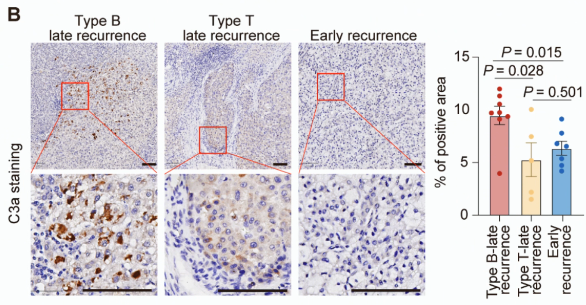
For key immunohistochemistry (IHC) detection of C3a in human HCC tumour tissues in this work, Cloud-Clone Complement Component 3a (C3a) polyclonal antibody (Cat.No. PAA387Hu01) was used, providing robust technical support for decoding this novel anti-tumour immune axis.
Notably, C3a also bears critical clinical relevance in clear-cell renal cell carcinoma immunotherapy. Studies have reported elevated C3a expression in renal carcinoma tissues, correlated with tumour stage and tumour size. During anti-PD-1 immunotherapy, shifts in C3a concentrations can partially reflect therapeutic outcomes: patients responding to treatment show reduced C3a levels, whereas progressive disease is associated with elevated C3a concentrations. These findings validate C3a as a promising biomarker for monitoring immunotherapy response.
Figure 1. Detection of complement C3a deposition in HCC tissues of different recurrence subtypes using Cloud-Clone C3a antibody
Cloud-Clone: One-Stop Solutions for Complement Research
As a key supplier for life-science research, Cloud-Clone addresses full-workflow requirements for complement research, delivering comprehensive toolkits for pathway dissection, biomarker detection, disease model development, drug screening and clinical translation.
1.High-purity Recombinant Proteins for Signaling Pathway Research Cloud-Clone supplies a broad portfolio of high-purity complement-related recombinant proteins covering C1q, C3, C4, C5, C3a, C5a, Factor B, Factor H, Factor I, Properdin, MBL, MASP, C1INH, CFHRs and other targets. Optimized for in-vitro cascade reconstruction, functional validation and drug target screening, these products undergo strict quality control to guarantee consistent batch-to-batch purity and biological activity.
2.High-Specificity Antibodies for Precise Target Recognition Cloud-Clone generates high-specificity antibodies targeting key complement molecules including C3a, C5a, C4d, membrane attack complex and C3 convertase. The portfolio comprises monoclonal and polyclonal antibodies against core complement components, activation products and regulatory proteins. Suitable for IHC, flow cytometry, Western Blot and immunofluorescence assays, these antibodies feature high specificity and low cross-reactivity, enabling precise localization and quantification at cellular and tissue levels.
3.High-sensitivity ELISA & CLIA Kits for Accurate Quantification Cloud-Clone’s high-sensitivity ELISA and chemiluminescent (CLIA) kits enable precise quantification of complement components and their activation products, covering nearly all key complement targets such as C3, C4, C1q, C3a, C5a, C4d, Factor H and MBL. Compatible with serum, plasma, cell culture supernatants and tissue homogenates, these kits feature wide detection ranges, low intra- and inter-assay variation and user-friendly workflows, ideal for large-sample screening and clinical-oriented testing.
4.Flow-Luminescent Immunoassay (FLIA) Multiplex Detection Kits for Efficient Simultaneous Measurement Based on flow-luminescence technology, Cloud-Clone offers multiple complement-focused multiplex assay kits for human, mouse and rat samples, enabling simultaneous quantification of targets including C3a, C4a, C1q, C5a, CFH and CFI. Product panels support research on systemic lupus erythematosus, IgA nephropathy, atherosclerosis, atypical haemolytic uraemic syndrome, age-related macular degeneration and other disorders. Characterized by low sample consumption, high throughput and superior sensitivity, these kits facilitate biomarker screening and systematic evaluation of complement activation pathways.
Figure 2. Recommended Cloud-Clone products for Complement Component 3a (C3a)
5.Customized Innovative Solutions To meet cutting-edge research and translational demands, Cloud-Clone provides custom services including custom development of proteins, antibodies and ELISA kits, construction of gene-knockout plasmids, and preparation of membrane attack complex (MAC). Backed by complete R&D and manufacturing infrastructure, Cloud-Clone delivers end-to-end one-stop services from target design and assay establishment to final product delivery, flexibly accommodating personalized requirements of advanced research projects and accelerating impactful scientific discoveries.
Published in Cancer Cell, this study expands mechanistic understanding of PD-1 blockade for HBV-associated hepatocellular carcinoma and highlights vast untapped research potential of the complement system in tumour immunology. High-performance research reagents form an indispensable foundation for major scientific breakthroughs. The successful application of Cloud-Clone C3a antibody in this project demonstrates how reagent performance shapes research outcomes.
Serving the global research community, Cloud-Clone will keep advancing product development for complement research, delivering consistently-performing recombinant proteins, antibodies and detection kits alongside flexible custom services. Cloud-Clone empowers global researchers to conduct complement-related basic research and clinical translation, accelerating the real-world application of immunological discoveries.
For more complement-research-related products, please visit Cloud-Clone official website: http://www.cloud-clone.com/
About Cloud-Clone Corp.
Cloud-Clone Corp. is dedicated to the development and production of high-quality immunoassay reagents and detection solutions. With a focus on antibody engineering, multiplex assay development, and cross-platform compatibility, the company provides research tools designed to support precision medicine and advanced biomedical investigation globally. Our core products and services include the research and development of proteins, antibodies, ELISA kits, primary cells, and multiplex cytokine assay kits, as well as professional CRO services to fully meet the diverse needs of biomedical research and related fields.
For more information about Cloud-Clone Corp, visit www.cloud-clone.com.
CLOUD-CLONE CORP.(CCC)
Tel: 001-832-538-0970, 0086-27-8425-9552
Email: mail@cloud-clone.com, sales@cloud-clone.us
Visit us on social media:
LinkedIn: https://www.linkedin.com/company/cloud-clone-corp/
Instagram: https://www.instagram.com/cloudclonecorp2023/
TickTok: https://www.tiktok.com/@cloudclonecorp2026
SuKi Duan
CLOUD-CLONE CORP.WUHAN
email us here
Visit us on social media:
LinkedIn
Instagram
TikTok
X
Legal Disclaimer:
EIN Presswire provides this news content “as is” without warranty of any kind. We do not accept any responsibility or liability
for the accuracy, content, images, videos, licenses, completeness, legality, or reliability of the information contained in this
article. If you have any complaints or copyright issues related to this article, kindly contact the author above.

Media gallery