
Key Takeaways
- Smocking gathers fabric into even pleats and holds them with embroidery stitches worked across the top, so the stitching is both the decoration and the structure.
- Shirring uses rows of elastic thread instead. The fabric puckers, but there are no defined pleats and no embroidery on the surface.
- Machine smocking tends to look flatter and very uniform, while hand smocking sits slightly raised, with small variations from one stitch to the next.
- A few simple checks, such as looking for elastic, running a fingertip across the panel and tilting it in the light, usually reveal which technique was used.
- Smocked pieces last longest when washed gently, never wrung, and reshaped while damp.
Walk through any shop that sells classic baby clothes and the word “smocked” shows up on bubbles, gowns, dresses and bibs. Look closer, though, and those panels are not all made the same way. Some are worked stitch by stitch by hand. Some come off a machine. And some are not smocking at all, but shirring, a different technique with a similar first impression.
For parents and grandparents choosing a gift, or anyone trying to understand why two “smocked” outfits feel so different, it helps to know what each technique is and what to look for. Nellapima, a baby clothing brand that works in Peruvian Pima cotton, recently published a detailed guide to what smocking is and how it is made, and much of what follows draws on that craft knowledge.
What Smocking Actually Is
Smocking starts with a flat piece of fabric and ends with a textured panel that moves. The cloth is drawn into narrow vertical pleats, and decorative stitches are worked across the tops of those pleats to hold them in place.
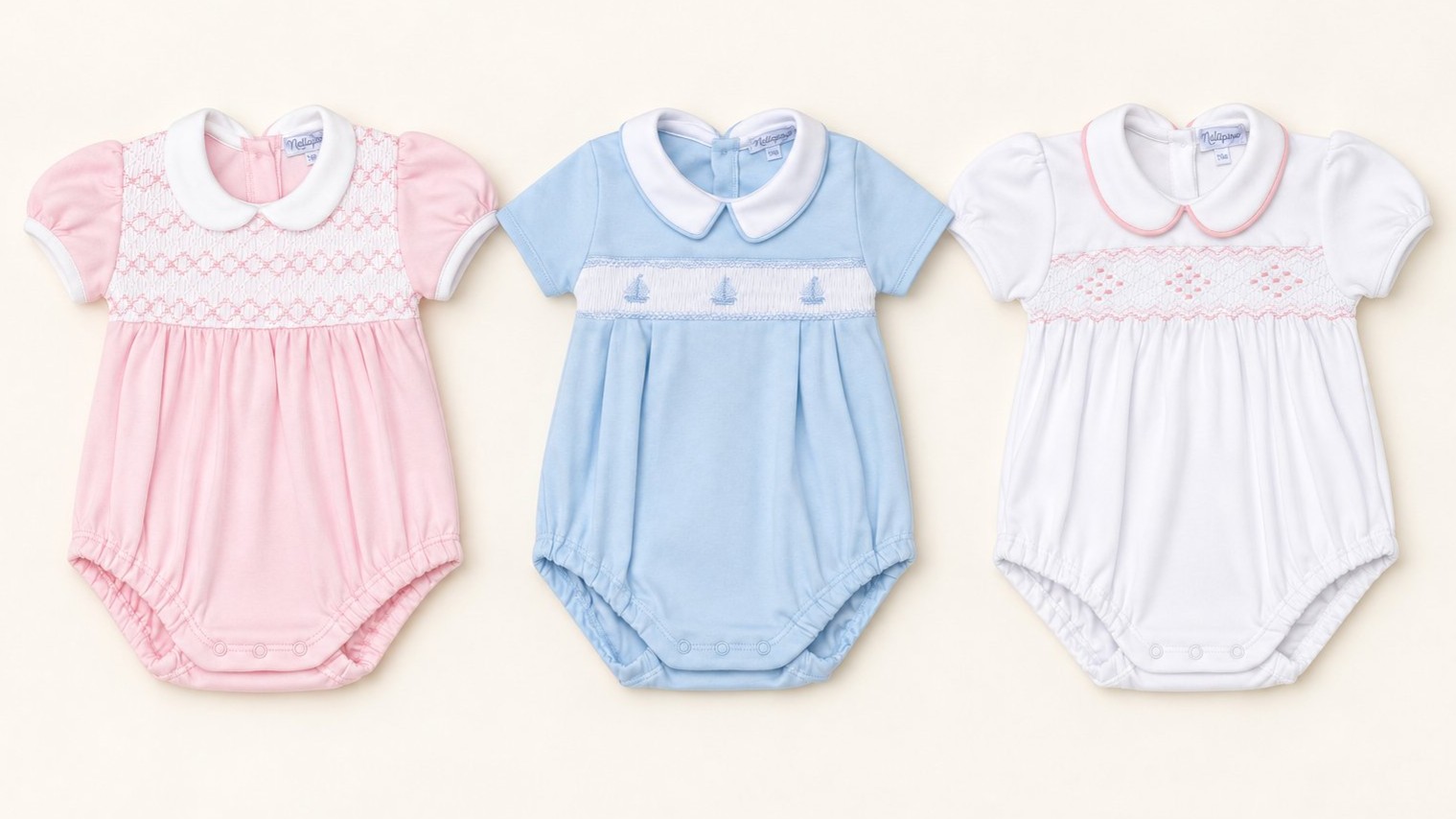
That is the key idea: in smocking, the embroidery is not added on top as an afterthought. It is what keeps the pleats together. Because the pleats can open and close a little, like an accordion, a smocked bodice gives slightly when a baby reaches for a toy or settles against a shoulder, then returns to shape.
The name comes from the smock, a loose, sturdy work garment worn in rural England in the 18th and 19th centuries. Gathering the fabric let those garments move with the body during a day of work. Over time the technique found its way into children’s clothes. Liberty of London helped revive smocked children’s dresses in the 1920s, and in the American South, the smocked baby bubble became the kind of outfit that still turns up in old family photographs.
Shirring Is Not Smocking
Shirring is the technique that gets labeled “smocked” most often by mistake. To make it, rows of elastic thread are sewn across the fabric. Once the elastic pulls in, the cloth bunches into a soft ripple.
On a hanger, a shirred panel and a smocked one can look alike. Pick them up, and they don’t feel the same at all:
- Shirring has no pleats, just an overall gather that bunches wherever the elastic pulls.
- Nothing is embroidered on top, so there’s no pattern to follow with the eye.
- The stretch comes from the elastic itself, so the panel tends to stretch farther and snap back more firmly.
Shirring has its place. It is quick to produce and comfortable to wear. It simply belongs to a different category than smocking, and a garment labeled “smocked” that turns out to be shirred is worth noticing before buying.
Simple gathering is different again. A single thread is pulled up to make a ruffle or fullness, with neither pleats nor stitched pattern. It reads as soft fullness rather than a design.
Machine Smocking: Even, Flat and Consistent
Machine smocking is a real technique with its own look, and plenty of people like it. Machines can pleat fabric and stitch patterns across it at a speed no hand can match.
The result is typically flatter and very uniform. Each stitch sits at the same tension and spacing as the last, which gives a clean, regular finish. For everyday pieces that will see heavy rotation, that consistency can be a plus.
What machine smocking usually lacks is depth. The stitches tend to lie closer to the fabric, and the surface reflects light evenly rather than shifting as the garment moves.
Hand Smocking: How It Is Made
Hand smocking follows a sequence that cannot be rushed without the shortcuts showing in the finished panel. Nellapima’s guide describes it in five steps:
- The fabric panel is cut wider than the finished piece, because the extra width becomes the pleats.
- Rows of gathering threads are run across the panel, by hand or with a pleater.
- The pleats are drawn up straight and even.
- Decorative stitches are worked across the tops of the pleats, row after row, until the pattern takes shape.
- The finished panel is set into the garment.
The third step is where patience matters most. If the pleats lean even slightly, every row of stitching that follows carries that lean into the finished piece.
Each stitch has its own name and look. Cable stitch is the sturdy one, forming a line that resembles twisted rope. Wave stitch zigzags up and down. Trellis creates diamonds, and honeycomb makes little cells that look a bit like a beehive. Picture smocking is the most detailed of all: a sailboat or a bow is built up one stitch at a time until a small scene sits across the front of a bubble.
Where to Find Smocking on Baby Clothes
Most smocking sits across the chest, because that’s where a baby’s outfit needs to hold its shape but still move. On a bubble, the smocked yoke starts just under the collar, and the rest of the fabric falls loose from there. A gown or footie usually has a narrower smocked band, which adds a special touch while keeping the piece soft enough to sleep in.
Bishop dresses take a different approach. The smocking wraps around the neckline, and the dress hangs from it in soft folds, a style that suits toddlers as well as babies. Smaller pieces, such as bibs and hats, often carry a single smocked band or a picture motif like a row of bows.
Because smocking reads as special without being fussy, it is a common choice for holidays, family photos, baptisms and first birthdays, as well as for gifts meant to be kept.
How to Tell Them Apart: A Quick Checklist
No single test is perfect, and a skilled hand smocker can work with remarkable precision. Still, a few checks usually point to the right answer.
Look for elastic. Turn the garment inside out. Rows of elastic thread on the back of the panel mean shirring, not smocking.
Look for pleats. True smocking has defined vertical pleats with stitching visible across their tops. A general pucker with no pattern is shirring or gathering.
Run a fingertip across the panel. Hand smocking usually has a slight relief under the thread. Machine smocking tends to feel flatter.
Tilt it in the light. Raised hand stitches throw tiny shadows, so the panel looks a little different from every angle. Machine-smocked panels look about the same however they’re held.
Look at the spacing. When a person does the stitching, a few stitches come out a hair wider or tighter than the rest. If every stitch across the whole panel is exactly the same, a machine probably made it.
Check the label. Plenty of brands say plainly how a piece was made. If the product page says “hand-smocked,” the checks above are a quick way to confirm it.
What the Technique Means for Fit and Keeping
For a garment that may be worn for a few months and then saved, the technique affects more than looks.
Hand smocking builds a panel that gives gently with movement, which keeps a bodice comfortable as a baby wiggles, reaches and grows. Fit still depends on each garment’s cut and length, so a size chart remains the best guide, but the natural give of the pleats helps.
The fabric matters too. Fine smocking stitches sit most cleanly on smooth, strong cloth. Peruvian Pima cotton is an extra-long-staple fiber, and long fibers make smooth, durable thread and fabric with a quiet luster. That combination is why many heirloom makers pair the two. Nellapima’s hand-smocked baby clothes in Peruvian Pima cotton include bubbles, gowns, footies, dresses and accessories, all made in Peru.
There is also the question of keeping. Smocked outfits are often the ones families hold onto for a younger sibling, a cousin or a future grandchild. A well-made hand-smocked panel, cared for properly, can hold its pleats through years of storage and another round of wear.
How to Care for Smocked Clothing
Whatever the technique, smocked pieces last longest with gentle handling. Always check the care label first, since it has the final word. As a general guide:
- Turn the piece inside out before washing.
- Use cool or lukewarm water on a gentle cycle, or wash by hand.
- Choose a mild detergent and skip the bleach.
- Never twist or wring the smocked panel.
- Reshape the pleats while the fabric is still damp, then dry flat or tumble on low.
- If pressing is needed, iron from the back on low heat and keep the iron off the embroidery so the stitches stay full.
These steps protect the pleats and keep the embroidery soft for the next child who wears the piece.
A Craft Worth Knowing
Smocking, shirring and machine smocking can all produce lovely clothes. Knowing the difference simply makes it easier to choose with confidence, whether the goal is an everyday outfit, a holiday photo or a keepsake meant to be passed down.
For Nellapima, hand smocking is a deliberate choice. The company has worked with Peruvian Pima cotton since 2016, and its Heritage line is where hand smocking and embroidery live. More about the family story behind Nellapima is available on the company’s website.
About Nellapima Nellapima is a baby and children’s clothing company that has been making pieces in Peru from 100% Peruvian Pima cotton since 2016. Its Heritage line features hand-smocked and embroidered designs for holidays, photos, gifts and keepsakes, and its Everyday line brings the same soft cotton to simpler styles. Nellapima’s children’s products are CPSIA compliant and tested in CPSC-accepted labs.
Nellapima
+1 713 904 5001
250 Spring Street Northwest
Showroom 13W354A
Atlanta
Georgia
30303
United States


