GA, UNITED STATES, May 11, 2026 /EINPresswire.com/ — A new review shows how PEDOT:PSS, a flexible conductive polymer, enables tactile sensors that mimic human touch. These sensors detect pressure, strain, and temperature, opening doors for smarter healthcare monitoring, robotics, and wearable electronics.
Imagine a prosthetic hand that can feel the warmth of a coffee cup, or a smart bandage that tracks your pulse and breathing. Scientists are now one step closer to making these a reality —thanks to a versatile material called PEDOT:PSS.
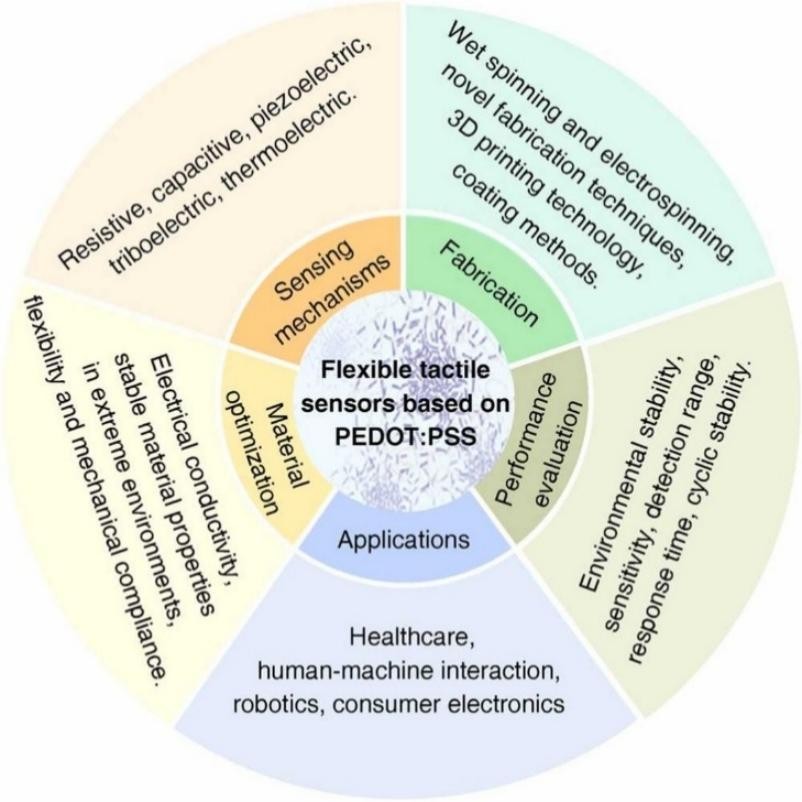
A review(doi: https://doi.org/10.1016/j.wees.2026.03.001) published in Wearable Electronics highlights how this conductive polymer is transforming flexible tactile sensors – devices that convert physical touch into electrical signals. Unlike rigid conventional sensors, PEDOT:PSS can be printed onto stretchable surfaces, making it ideal for wearable skin patches, soft robot fingers, and even smart clothing.
The research team analyzed how PEDOT:PSS-based sensors detect pressure, stretching, and temperature. “Simply put, when you press or warm the material, its internal conductive pathways rearrange, much like our own nerves sending touch signals to the brain,” says senior and co-corresponding author Qiang Zhao from Nanjing University of Posts & Telecommunications.
By mixing PEDOT:PSS with carbon nanotubes or designing micro-cracked films, the sensors can sense a light touch of 82 Pa (about the pressure of a falling leaf), respond in 20 ms (faster than a blink), and survive 10,000 use cycles. “They even work at –60 ℃ and in high humidity, making them suitable for polar exploration or sweaty fitness trackers,” adds Zhao.
The review also showed that PEDOT:PSS is not just a laboratory curiosity, it is a practical platform for building next‑generation tactile systems that are flexible, multifunctional, and scalable. “We are particularly excited about its potential for self‑powered sensing, where the same material generates electricity from body heat to run the sensor,” says Zhao.
The researchers also covered real‑world applications: from monitoring heartbeat and gait in healthcare, to enabling robotic grippers that distinguish object sizes, to touch‑sensitive smart textiles and non‑contact keyboards.
“While challenges remain, such as improving long‑term stability and making manufacturing more eco‑friendly, the authors are optimistic that PEDOT:PSS will be a key player in the coming era of intelligent, human‑friendly electronics,” says Zhao.
DOI
10.1016/j.wees.2026.03.001
Original Source URL
https://doi.org/10.1016/j.wees.2026.03.001
Funding information
This research was supported by the National Natural Science Foundation of China (Nos. 62288102 and 62375142) and the Basic Research Program of Jiangsu (No. BK20243057).
Lucy Wang
BioDesign Research
email us here
Legal Disclaimer:
EIN Presswire provides this news content “as is” without warranty of any kind. We do not accept any responsibility or liability
for the accuracy, content, images, videos, licenses, completeness, legality, or reliability of the information contained in this
article. If you have any complaints or copyright issues related to this article, kindly contact the author above.

Media gallery