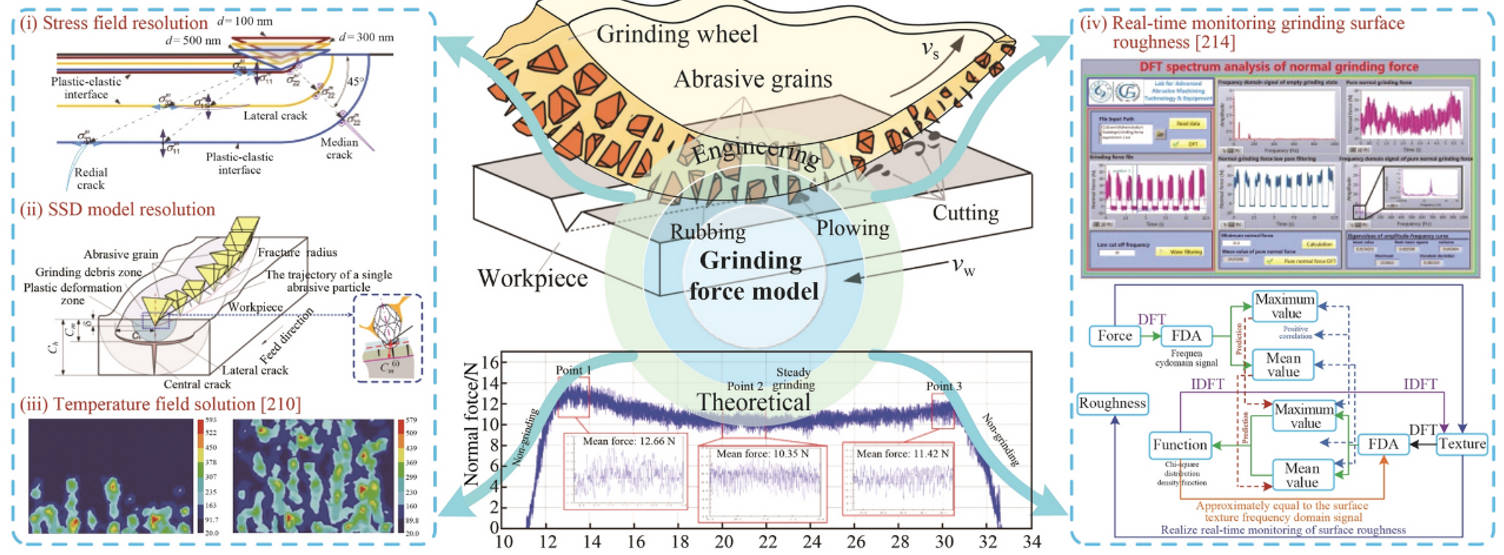
GA, UNITED STATES, July 29, 2026 /EINPresswire.com/ — Advanced ceramics can survive extreme heat, corrosion, wear and demanding mechanical loads, yet shaping them precisely often creates cracks that undermine the very performance engineers seek. A research team has now organized decades of work on ceramic grinding into a unified account linking microscopic material removal, grinding-force prediction and machining damage. The review explains how individual abrasive grains drive elastic deformation, plastic flow and brittle fracture, and shows why force signals can serve as a practical window into these otherwise hidden transitions. By connecting removal physics with increasingly realistic computational and analytical models, the work provides a roadmap for designing faster, more predictable and lower-damage grinding processes for ceramics and other hard, brittle solids.
Advanced ceramics are essential in cutting tools, bearings, seals and components exposed to high temperatures, but their hardness and brittleness make precision machining slow, costly and damage-prone. Grinding can deliver accurate dimensions and smooth surfaces, yet its outcome depends on many interacting factors, including abrasive-grain shape, wheel structure, cutting depth, speed, temperature and crack growth. Earlier empirical models can reproduce selected experiments but often struggle when materials, tools or processing conditions change. Numerical simulations also face scale, constitutive and computational limits, while analytical models depend heavily on simplifying assumptions that may not reflect real wheel-workpiece contact. Based on these challenges, deeper research is needed into physically grounded grinding-force models that connect grain-scale contact, fracture behavior and measurable surface damage.
On March 25, 2025, researchers led by the School of Mechanical and Automotive Engineering at Qingdao University of Technology, with collaborators from Taishan Sports Industry Group Co., Ltd., Ahmadu Bello University and Qingdao Kaws Intelligent Manufacturing Co., Ltd., published (DOI: 10.1007/s40436-025-00553-0) the review in Advances in Manufacturing. Drawing on experimental, numerical and analytical studies, the team evaluated ceramic material-removal mechanisms, compared major grinding-force modeling routes, examined ultrasonic vibration- and laser-assisted grinding, and assessed how force models can support predictions of cracks, temperature, stress and final surface quality.
The review first synthesizes evidence from single-grain scratching, multigrain interference experiments, finite element analysis and molecular dynamics simulations. It then reconstructs the main modeling chain: representing the random geometry, size, orientation and protrusion height of abrasive grains; calculating their motion and instantaneous undeformed chip thickness (UCT); identifying elastic rubbing, plastic plowing, ductile cutting and brittle removal; and summing the forces generated by active grains. Across the literature, increasing penetration generally shifts ceramic removal from elastic response to plastic deformation and then brittle fracture, with force signals rising and fluctuating as cracks initiate, join and reach the surface. At the grain scale, dislocation accumulation, amorphization and stress concentration help explain how damage develops around boundaries and pores. The authors found that realistic, stochastic grinding-wheel descriptions and models incorporating dynamic grain behavior offer better predictive potential than simplified average-force approaches. Properly controlled ultrasonic vibration and laser assistance can reduce forces or improve surface integrity, but their changing contact, impact, friction and thermal conditions make force prediction more difficult. The review also shows that force models can feed calculations of subsurface crack depth, grinding temperature and stress fields, while processed force signals can be correlated with surface-quality features for online monitoring and process adjustment.
The authors said the review’s central message is that grinding force should be treated not merely as an output of machining, but as a bridge between microscopic removal events and the quality of the finished ceramic part. They said future models must capture how abrasive grains move, wear and interact with evolving crack networks, temperature and material conditions, rather than relying on fixed correction factors. Such models, they added, would make energy-assisted grinding easier to control, improve confidence in process decisions and help manufacturers detect damaging transitions before defects become embedded beneath the surface.
The framework could guide the selection of wheel structures, speeds, depths and assistance strategies for precision ceramic components used in aerospace, nuclear energy, electronics, bearings, sealing systems and high-temperature machinery. More reliable force prediction may help manufacturers reduce surface pits and hidden cracks while balancing productivity, tool life and energy use. The review also points toward intelligent grinding systems that combine real-time force sensing with signal analysis to track removal states and surface quality during production. Its broader implication is a shift from trial-and-error parameter tuning toward physics-informed control, although further work is needed to validate microscopic models across polycrystalline ceramics, ceramic composites and combined energy-field processes under realistic industrial conditions and changing tool states.
References
DOI
10.1007/s40436-025-00553-0
Original Source URL
https://doi.org/10.1007/s40436-025-00553-0
Funding information
This work was supported by the National Natural Science Foundation of China (Grant Nos. 52375447, 52305477, 52205481, and 52105457), Shandong Natural Science Foundation (Grant Nos. ZR2022QE028 and ZR2023QE057), the Science and Technology SMEs Innovation Capacity Improvement Project of Shandong Province (Grant No. 2022TSGC1115), and the Special Fund of Taishan Scholars Project.
Lucy Wang
BioDesign Research
email us here
Legal Disclaimer:
EIN Presswire provides this news content “as is” without warranty of any kind. We do not accept any responsibility or liability
for the accuracy, content, images, videos, licenses, completeness, legality, or reliability of the information contained in this
article. If you have any complaints or copyright issues related to this article, kindly contact the author above.

Media gallery