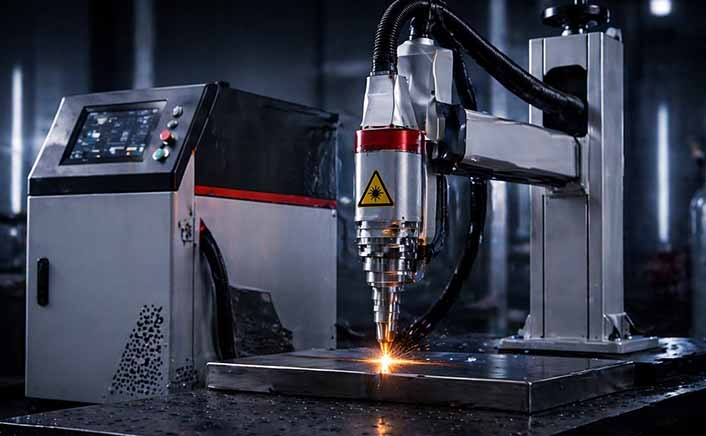
The Global Laser Welding Machine Industry is undergoing one of its most dynamic growth phases in recent history. The Laser Welding Machine Market recorded a sales volume of 95,000 units in 2025 and is estimated to reach 192,210 units by 2033, expanding at a CAGR of 9.1% during the forecast period, effectively more than doubling its current volume within eight years.
This is not incremental growth. It is a market being reshaped by structural forces: the global transition to electric vehicles, the proliferation of lightweight materials in manufacturing, the miniaturization of electronics, and the irreversible march toward automated production lines. Together, these forces are creating demand conditions that laser welding technology is uniquely positioned to meet.
Access the Full Report Here: https://marksparksolutions.com/reports/laser-welding-machine-market
The Electric Vehicle Effect
The automotive industry accounts for approximately 35% of the overall demand for laser welding machines, making it the largest end-use sector. Within the automotive industry, the most transformative force is the rapid global scaling of electric-vehicle production.
EV manufacturing places extraordinary demands on welding technology. Battery assembly, specifically cell-to-tab and module assembly, requires high precision, minimal heat distortion, and consistently strong, reliable joints. Laser welding systems deliver high-speed, repeatable results with minimal material damage, making them the preferred solution as EV production volumes increase across major manufacturing economies.
Beyond battery assembly, automakers are accelerating the adoption of lightweight vehicle structures made from aluminum and advanced high-strength steel, which require specialized welding techniques to preserve structural integrity without compromising performance. Laser welding’s ability to deliver deep penetration and narrow weld seams makes it particularly well-suited to these materials. The widespread integration of laser welding systems into robotic body assembly lines, where faster cycle times and reduced labor dependency are operational imperatives, further cements the automotive sector’s role as the market’s central growth engine.
Request for a Free Sample Report @ https://marksparksolutions.com/sample-reports?760&Download_Free_Sample
Technology Segmentation: Fiber Lasers Pull Away from the Field
Across laser types, fiber laser welding machines have become the dominant technology. Their superiority stems from exceptional beam quality, high electrical efficiency often exceeding 30%, and lower maintenance requirements compared to legacy systems. These characteristics make them particularly well-suited to the automotive, electronics, and EV battery sectors, which are experiencing the strongest demand growth.
CO₂ laser welding machines retain a meaningful share, particularly for thicker materials and certain non-metal applications, but are gradually losing ground as industries migrate toward more efficient alternatives. Nd: YAG solid-state lasers continue to serve niche applications in medical device manufacturing and micro-welding, though their adoption is constrained by fiber systems that match or exceed their performance while offering better energy efficiency.
Diode and disk lasers represent emerging, specialized segments. Diode lasers are gaining traction for their compact design and suitability for localized heating applications. In contrast, disk lasers are increasingly used in high-power, heavy-duty automotive and industrial environments where deep penetration and high output are required. The overall technology trajectory clearly points toward fiber-based systems, driven by ongoing cost reductions and performance improvements.
Power Output Tiers Reflect a Diverse Industrial Base
Medium-power systems in the 1 to 3 kW range lead the market with a 42% share, owing to their versatility in high-volume manufacturing settings. These systems balance cost efficiency and performance, serving automotive component fabrication, general metal fabrication, and mid-tier industrial assembly, making them the functional backbone of the industry.
High-power systems above 3 kW follow with a 30% share, driven by capital-intensive applications such as automotive body-in-white welding, aerospace structural fabrication, and heavy industrial manufacturing. As EV platforms demand increasingly rigorous battery enclosure and chassis welding, this segment is positioned for above-average growth over the forecast period.
Low-power systems below 1 kW account for the remaining 28% of the market. Although smaller in volume, this segment commands a premium due to the stringent tolerances required in semiconductor packaging, medical device assembly, and microelectronics manufacturing. Ongoing miniaturization in consumer electronics and the growing sophistication of implantable medical devices are expected to sustain steady demand.
Download Free Sample Report: https://marksparksolutions.com/sample-reports?760&Ask_for_Discount
Regional Pricing: A Market of Distinct Tiers
The global pricing landscape shows pronounced regional stratification. North America commands an 18 to 20% premium over the global average, driven by strong demand from advanced manufacturing sectors and a preference for fully automated, high-specification systems integrated with robotics and smart manufacturing platforms. Stringent quality requirements and a focus on long-term productivity optimization further justify this premium positioning.
Europe commands a 9 to 11% premium, supported by CE certification requirements and the precision manufacturing cultures of countries such as Germany and Italy. The Asia Pacific region trades at a 12 to 15% discount relative to the global average, driven by cost-competitive manufacturers in China and South Korea. However, this gap is gradually narrowing as demand for high-end fiber laser systems grows across electronics and EV manufacturing.
The Middle East and Africa are the lowest-priced tier, with discounts of 24 to 26%, reflecting earlier-stage industrial development and reliance on imported machinery. Across all regions, a price CAGR of approximately 3.0% is projected from 2024 to 2033, indicating that premiumization trends and technological advancement are steadily outpacing competitive pricing pressures.
Competitive Landscape
The Laser Welding Machine Market features globally recognized technology leaders competing on beam quality, system integration, power range, and application expertise. Key companies evaluated in this space include TRUMPF, IPG Photonics, Coherent, AMADA WELD TECH, Jenoptik, LaserStar Technologies, and EMAG Group, among other prominent participants.
TRUMPF maintains a comprehensive portfolio spanning laser sources, systems, and application engineering, with a strong presence across automotive, electronics, and medical manufacturing. IPG Photonics, widely regarded as the pioneer of high-power fiber laser technology, holds a commanding position in the fiber segment, supported by a vertically integrated manufacturing model that delivers structural cost and quality advantages. Coherent brings a broad photonics portfolio serving customers across the full laser processing spectrum, while AMADA WELD TECH specializes in precision welding for medical and electronics applications. Jenoptik focuses on the automotive and semiconductor segments, LaserStar Technologies serves compact precision applications in the jewelry, medical, and electronics markets, and EMAG Group differentiates through integrated manufacturing cell solutions tailored for automotive production lines.
Differentiation across the competitive field is increasingly centered on software intelligence, process monitoring, and seamless robotic integration, shifting the battleground from hardware specifications to total system value through 2033.
Media Contact
Company Name: Mark & Spark Solutions
Contact Person: Sushil
Email: Send Email
Phone: 9158340999
Address:2nd Floor, Panchsheel Park, Aundh
City: Pune
State: Maharashtra
Country: India
Website: https://marksparksolutions.com
Press Release Distributed by ABNewswire.com
To view the original version on ABNewswire visit: Laser Welding Machine Market on Track to More than Double by 2033, Fuelled by Electric Vehicle Surge and Precision Manufacturing Demand